Ten things you can get at your local Big Box store to help build your healthy home
Looking for last minute gift ideas? Here are ten things you can get at your local Big Box store to help build your healthy home. You can’t get all the materials you need at a Big Box store, but if you know what to look for, you can make choices that significantly improve durability, moisture control, and indoor air quality.

Fiberglass rebar can be a good option in certain slab and foundation applications. It doesn’t have the thermal bridging potential of steel rebar, and since it can’t be used as a ufer ground, it is safer from an EMR perspective.
EPS is the best kind of insulation to use in a foundation, because it tolerates moisture. Depending on your climate, use two layers of 1 ½” insulation, staggering and taping the seams. Sandwich it between a capillary break of ¾” clean crushed rock underneath and a taped Stego vapor barrier on top.

Plywood is the most vapor permeable of the sheathing options. Look for exterior plywood that is made with phenol formaldehyde instead of urea formaldehyde to reduce VOCs. Cover it with a vapor permeable peel and stick WRB.
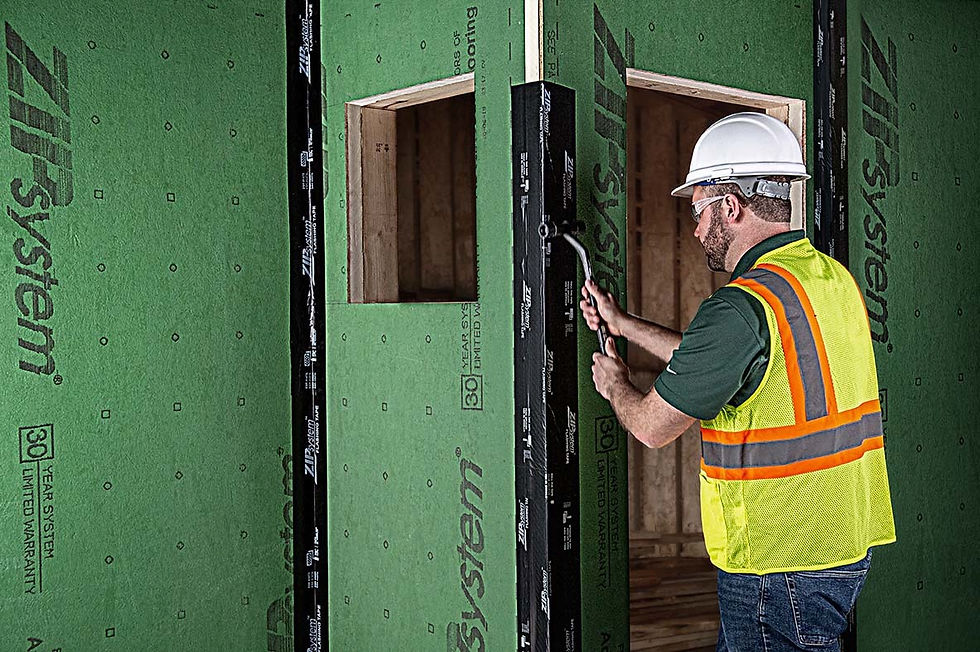
Zip Sheathing is probably the easiest high performance assembly for a “normal contractor” to build and can work great - as long as you ROLL THE TAPE! Have multiple rollers on hand with your build, and look for the little Z in the tape to verify that your framers are using them.
Every build will get rained or snowed on at some point - it’s almost a guarantee. Have large billboard-style tarps (the heavy-duty kind) on hand to protect the build, and fans, brooms, and shop vacs on hand to dry it out as quickly as possible.
The best way to prevent mold under your flooring is to make sure no water is being trapped under it. Make sure you install a proper taped vapor barrier and capillary break under the foundation as a first line of defense. When you install your finish flooring, install an underlayment that gives any residual vapor a path to dry out.
Tile is not inherently waterproof! It’s important to make sure your bath and shower surrounds are waterproof before the tile goes on. Schluter is one system you can use. Make sure your contractor uses the proper transition pieces for the drain and the fixtures, and follows the installation instructions.

Save money on tile so that you can spend it where it matters most - proper waterproofing underneath by buying your tile at Home Depot or Lowes. Home Depot has lots more tile available online than in the store and you can order samples. Using 12x24” tiles will minimize grout lines while still being affordable.
Caulk should be your last line of defense against water, not your first, but it’s still an important step. Make sure your bathroom and kitchen are properly caulked when they are built, check it every year, and refresh it about every 3 years. 100% silicon caulk is more water resistant and has less VOCs.
A properly-applied fully-adhered underlayment will protect your roof from precipitation and ice dams, and is less likely to blow off in a storm before the roof is installed. Make sure the underlayment is properly lapped, extends ¼"–½" past the roof sheathing at the eave. Make sure the high-risk areas: penetrations, valleys, roof-to-wall connections, rakes, and low-pitch areas are properly waterproofed. The fully-adhered underlayments available at the big box stores are not vapor permeable. Depending on your assembly, you may need to use a more permeable underlayment from a specialty supplier.
Want to learn how all these pieces fit together? Check out my class - Building a Healthy and Resilient Home.
Jen Jobart
Build Science Educator and Healthy Home Consultant
Practical Healthy Homes
PS These are not affiliate links. I include them for your benefit only.


Comments